Optical Interconnect Supply Chain Restructuring and Opportunities in Response to Expanded US Export
摘要
內容
As U.S. export controls extend from chips to AI infrastructure, the traditional optical interconnect industry is undergoing supply chain restructuring. While optical modules are not subject to blanket bans, they are now governed by system‑level controls. By leveraging its semiconductor ecosystem and investing in SiPh, CPO, advanced packaging and testing capabilities, Taiwan can capture North American supply‑chain de‑risking demand and reposition itself as a strategic AI partner.
Key Highlights
- Systemic shift in controls: U.S. export controls have expanded from individual chips to entire AI computing systems. Optical interconnect products are not banned as standalone items, but are now subject to stringent compliance review through end‑use and system‑linkage mechanisms.
- Reshaped supply‑chain logic: For AI data centers, procurement priorities are shifting from cost to compliance and supply‑chain security. Out‑of‑China (OOC) capacity and end‑to‑end supply‑chain transparency have become mandatory entry requirements for the North American market.
- Integration as the core driver: De‑risking opportunities are not about low‑cost substitution, but about integrating semiconductor foundry services, advanced 2.5D/3D packaging and high‑precision E/O testing to enable 1.6T‑class and beyond optical modules and CPO solutions.
- Taiwan's ecosystem advantage: With a one‑stop value chain spanning wafer fabrication, advanced packaging and system assembly, Taiwan is strategically positioned in SiPh and CPO, with the potential to absorb order overflows from global leaders and drive structural industry upgrading.
Table of Contents
- US Export Controls Remain Focused on Advanced Computing, but Impacts Are Spilling Over into the AI Infrastructure Supply Chain
- Optical Interconnects Are Not Subject to Standalone Embargoes but Face “Collateral Controls”
- The Rationale for Shifting Away from Chinese Suppliers Is Stronger in AI Optical Interconnects Than in Traditional Telecom Equipment
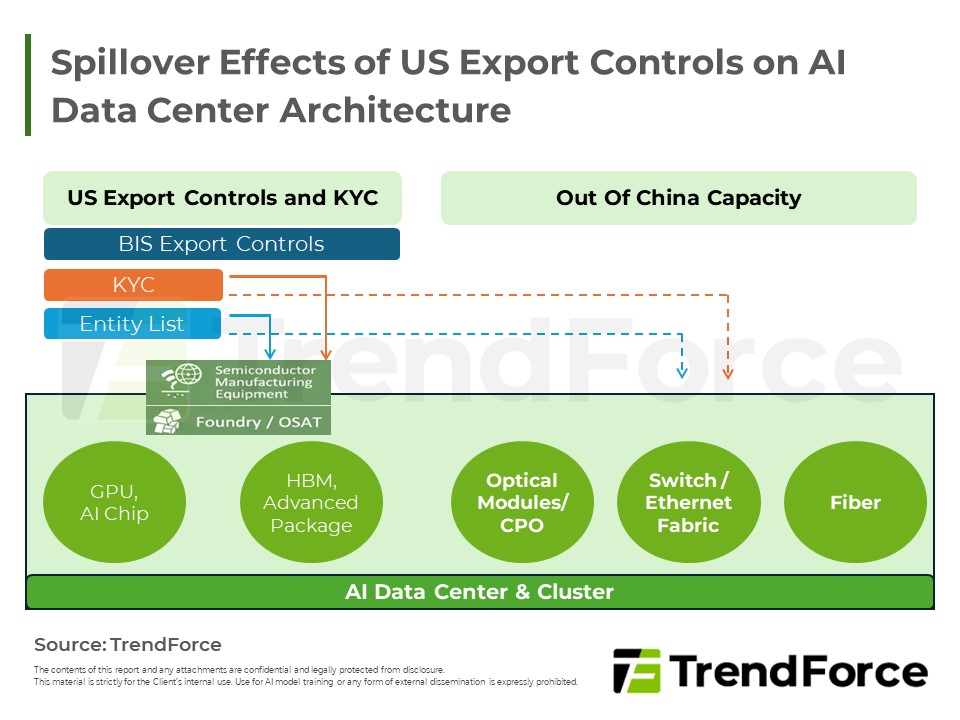
- Spillover Effects of US Export Controls on AI Data Center Architecture
- Advantages Taiwan’s and Non-Chinese Supply Chains Lie in High-End Optical Interconnects and Semiconductor Ecosystem Integration, Not Low-Cost Substitution
- Three Major Commercial Opportunities for Taiwanese Optical interconnect Vendors under De-Sinicization
- Key Penetration Points for Taiwanese Tech Industry in Pluggable Transceivers and SiPh/CPO Optical Interconnects
- AI Optical Interconnect Supply Chain Officially Incorporated into Strategic Review System Despite Persisting Variables for US Policies
- TrendForce’s View: New Entrants’ Opportunity Lies in Filling the Global Gap in Non-Chinese AI Optical Interconnect Capabilities
- Structural Gap in Optical Interconnects Created by Global De‑Sinicization Efforts
<Total Pages: 14>